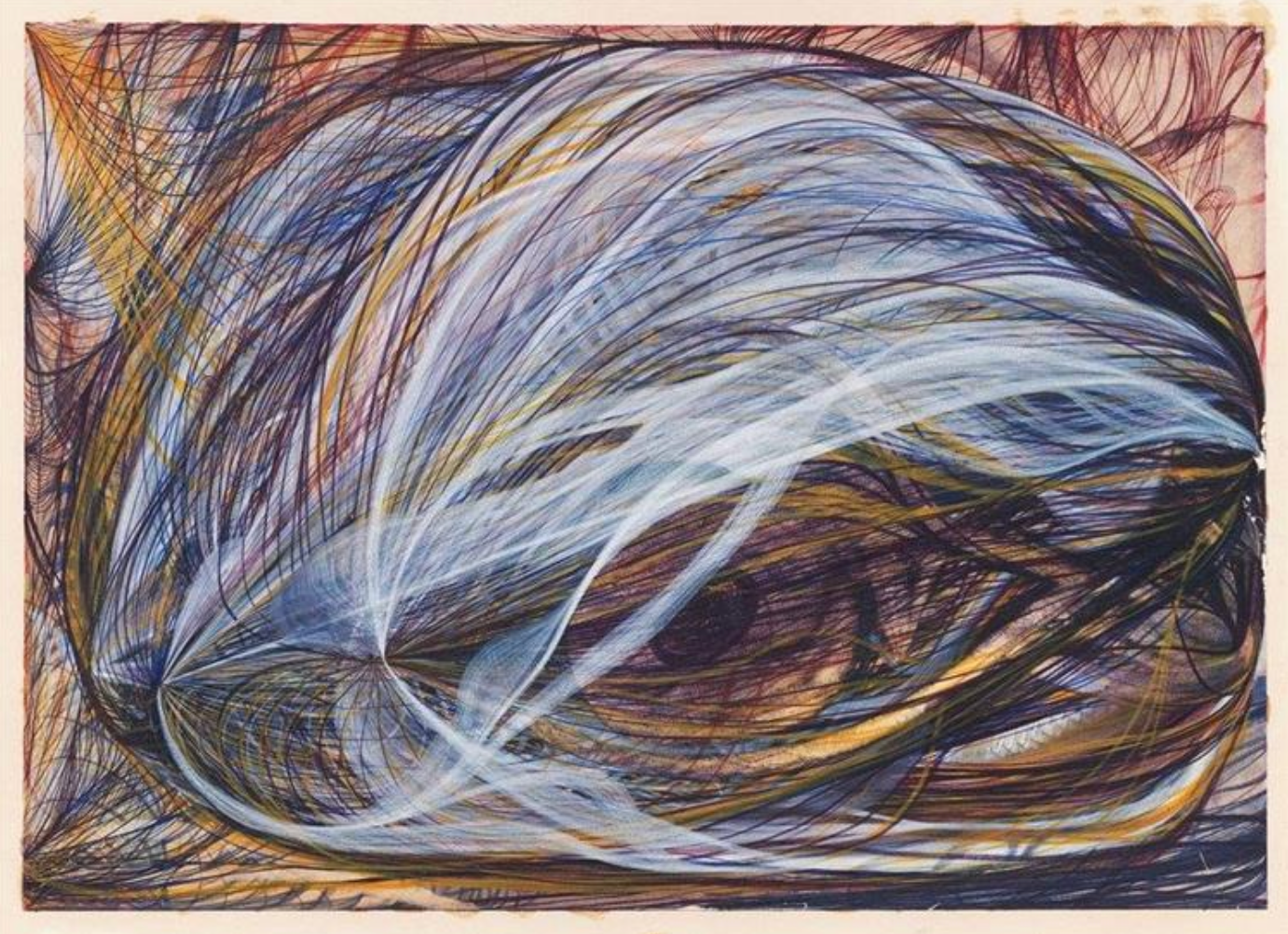
The Eye of the Lord, Georgiana Houghton, 1870. Source: https://www.wikiart.org/pt/georgiana-houghton/the-eye-of-the-lord-1870
Incarnate Revolt: The Manifestation of the Invisible in the Paintings of Georgiana Houghton
Abstract:
Inspired by Georges Didi-Huberman’s concept of incarnate painting, I investigate Georgiana Houghton’s abstract art practice as a phenomenon of manifestation. Her spirals disrupted the linearity of nineteenth-century academic art, evoking a turbulent movement of insubordination that destabilizes the gaze and produces a pictorial experience marked by tension between the visible and the invisible. In doing so, Houghton anticipates debates on abstraction and on indices of presence in painting.
Inspired by Georges Didi-Huberman’s concept of incarnate painting, I investigate Georgiana Houghton’s abstract art practice as a phenomenon of manifestation. Her spirals disrupted the linearity of nineteenth-century academic art, evoking a turbulent movement of insubordination that destabilizes the gaze and produces a pictorial experience marked by tension between the visible and the invisible. In doing so, Houghton anticipates debates on abstraction and on indices of presence in painting.
Keywords: Georgiana Houghton; incarnate painting; abstraction; spiraling; revolt; trace.
The Spirits say that when once the fact is acknowledged that they can work through a mortal hand, it is not really more surprising when they draw through a medium who lias not learned than through one who has; they can of course better guide the trained hand, and make a more speedy progress if they are thus relieved from all the elementary part, which must be gone through, for no person can spring, at one bound, to a pinnacle of art perfection, any-m ore than an acorn can in one season become a widely spreading oak. (Houghton, Georgiana, 1871, p.5)
In the summer of 1859, following the death of her sister, Georgiana Houghton and her mother would sit every night in ritual, placing their hands upon the table, as if awaiting guidance or the occurrence of something.
The table, a passive object, remained motionless. A few months later, it began to present slight vibrations: a tilt, an almost imperceptible touch, as though a fragile, invisible finger gently pressed upon its surface. From that moment on, the meetings were sacralized and took place on Sundays.
Soon after, sinuous curves in uninterrupted lines were traced by the turning table—or rather, at that moment, by Henry Lenny, the ghost of a deaf-mute man who guided the gesture and the movement. Miss Houghton claimed she simply obeyed; nevertheless, she offered her own revolted body-as-table as a disobedient instrument through which the occult revealed itself.
Over the course of a year, she used a planchette, a psychographic drawing board, a mechanical instrument through which the artist traced visualizations of drawings, forms, and studies of curves. Gradually, the gesture became even freer, abandoning the planchette and using only her hands to incarnate drawings on paper. The pencil soon yielded to the chromatic complexity of watercolor, as she began to perceive that the accompanying colors were themselves embedded with meaning, forming their own dictionary of color.
Without preliminary sketches, she maintained gestural freedom in creating compositions and emphasized that her hands were guided by spirits—an assertion that marked her departure from individual and conventional authorship for the time.
The abstractions that emerged were spiral labyrinths of color and form, without perspective or central figure. Untamed, spiraling visions that turned upon themselves and interwove in a circular, temporalizing movement of wild and revolted brushstrokes.
The spiritual dimension of art is not burdened with mimetic representation; rather, it carries the spirit of a time, an era, a moment. Thus, the primitive—proper to one who does something for the first time in a pioneering way—is the liberation of the soul through a genuine act within a specific temporal and spatial duration. Each mark is imaginary before becoming a graphic delimitation upon the surface. The contour that defines and delineates form, as abstract painter Wassily Kandinsky describes in Concerning the Spiritual in Art (1996), is the manifestation of this ambiguous content. To manifest traces is to make visible abstraction itself—non-representational of any real object and produced through basic forms: squares, circles, curves, and lines. Each scratch or brushstroke generates a vibration upon the surface, revealing to the eye the inaudible associations of these vibrations—this spiritual dimension of which Kandinsky speaks:
“[...] in art, what is veiled is more powerful. Combining what is veiled with what is allowed to be revealed leads to the discovery of new leitmotifs in a composition of forms.” (1996, p. 82)
In 1871, Georgiana Houghton rented a space at the New British Gallery in London and spread her drawings across a table like tarot cards. Critics looked upon them with suspicion; some murmured about delusions, others compared her colors to fevers. Yet many lingered, hypnotized by her spirals and interwoven contours.
Houghton was erased from the main pages of art history, remaining hidden and marginal, ghostlike, while other names advanced. Nevertheless, she was always there—like one who understands the spiral of time and waits for something to happen. Georgiana Houghton’s world never ceased to turn: she painted the invisible before the invisible was permitted in art, before Wassily Kandinsky and all those who later claimed the invention of abstraction.
When understood through the etymology of the word revolt, her spirals carry both circular movement and a gesture of insubordination against the artistic conventions of her time. If revolt derives from revolvere—“to roll back,” “to turn again”—we may understand her spirals as a pictorial inscription of this movement, in which the line not only advances but returns upon itself, creating a space of vibration between past and future, presence and absence.
Houghton brought us gesture in constant motion: a revolted female body, gesturally and pictorially insubordinate, contorting the linear perspective of the nineteenth century into a flow that resists rational order and returns in reactive cycles of reconnection. Her disoriented gestural revolts dissolve the center and unsettle the gaze until the very logic of perception bends, producing an experience of renewed contact with the unknown that insists on revealing itself. By setting the act of seeing itself into motion, painting becomes a vortex in which the invisible incarnates in matter.
In Spirit Drawings in Water Colours (1871), Georgiana Houghton describes her hand as guided by something beyond herself, turning paint into deposit and trace—a diluted, aqueous, unpredictable boundary with a certain transparency that, once absorbed, penetrates the fibers of the surface and settles between what has been and what still vibrates, like a residual pulse and an index of presence and contact. A vibrant apparition that intertwines the world of incarnated matter with the invisible.
Georges Didi-Huberman’s Incarnate Painting (2012) itself places tension between image and flesh, as though Houghton’s pictorial surface were a living body that, rather than merely representing, manifests. Miss Houghton painted the field in which gesture and matter collide and spiral in a pulsating manner.
The traced invisible incarnated there as skin—an expanded epidermis, organism-colors, and impregnated materiality. In this context, her paintings were not decisions but phenomena of revelation.
The pictorial surface can be understood as a field of presence—not merely as spiritual records, but as radical experiments in painting, in which matter becomes a vestige of the invisible and a means of contact between dimensions. Georgiana Houghton allowed us to touch what escapes and presented presences that insist on not disappearing.
References
DIDI-HUBERMAN, Georges. A PINTURA ENCARNADA: seguido de A Obra-Prima Desconhecida de Honoré de Balzac. 1 ̊ Ed. São Paulo: Editora FAP-UNIFESP, Editora Escuta Ltda., 2012.
HOUGHTON, Georgiana. CATALOGUE OF THE SPIRIT DRAWINGS IN WATER COLOURS Exhibited at the New British Gallery, Old Bond Street. Public Library of Victoria,1871.
KANDINSKY , Wassily. DO ESPIRITUAL NA ARTE e na pintura em particular. São Paulo: Martins Fontes, 1996.